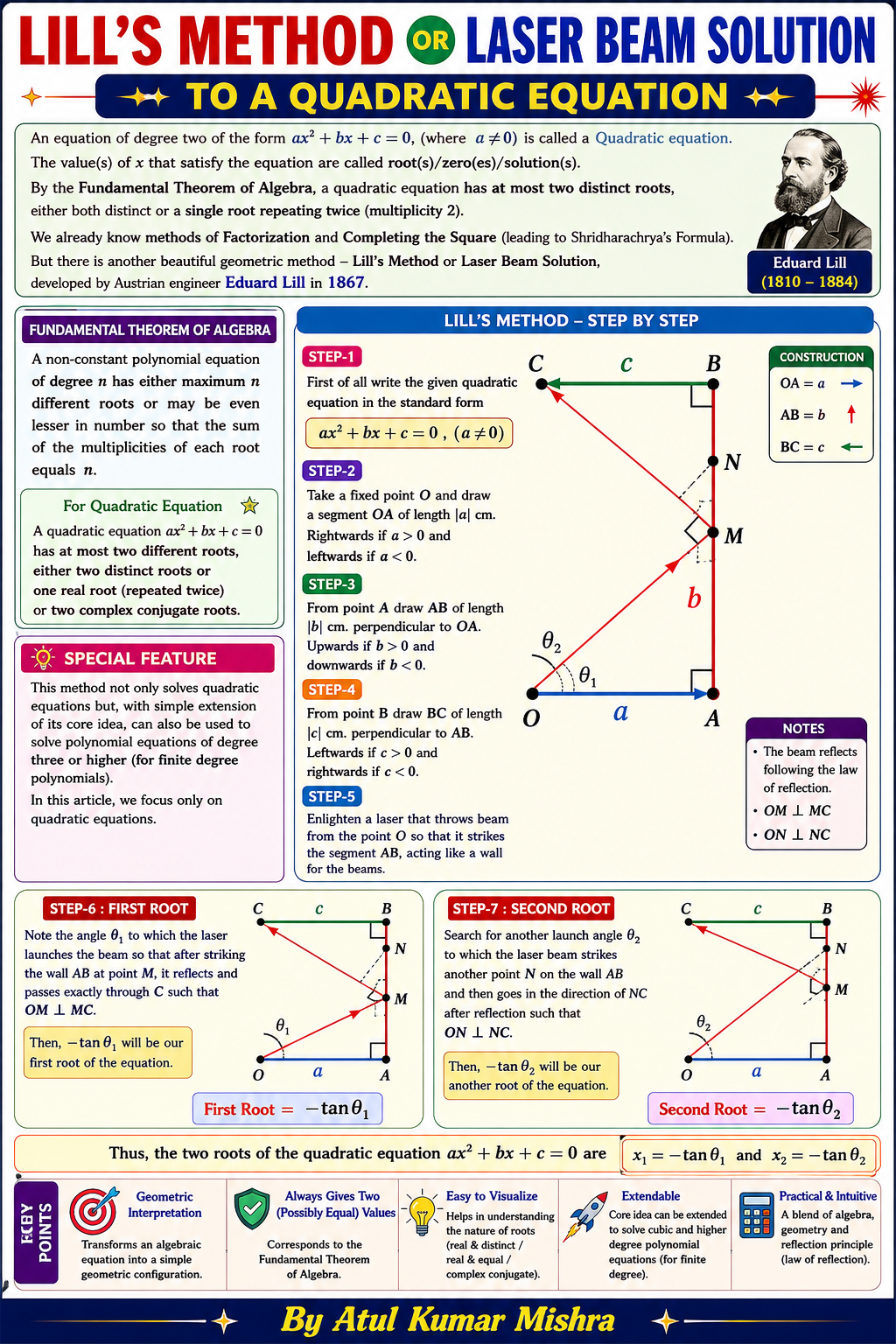

Lill's Method or Laser Beam Solution to a Quadratic Equation : -
Dear students, we already know that an equation of degree two of the form, ax²+bx+c=0, (where 'a' is non-zero) is called a Quadratic equation. The value(s) of x such that when substituted in the left hand side of the equation giving zero or equal to the right hand side of the equation (or even said to satisfy the above given quadratic equation) is(are) called root(s)/zero(es)/solution(s) to this quadratic equation. As we know from the Fundamental Theorem of Algebra that a non-constant polynomial equation of degree 'n' has either maximum 'n' different roots or may be even lesser in no. so that the multiplicities of each when added coming out to equal to 'n.' So by its application we can say that a given quadratic equation has atmost two different roots, either both distinct or a single root that repeats twice i.e. having a multiplicity of 2. We have also learned two most famously known methods to solve a given quadratic equation viz. one is by the method of factorization and the second method by completing the perfect square that further leads a formula popularly known as Shridharachrya's Formula. But hold on! What if I tell you there is one more method called Lill's Method or Laser Beam Solution to a quadratic Equation developed by an Austrian engineer Eduard Lill in 1867.
The special thing about this method is not that it can solve a quadratic equation but a simple extension and understanding of the core idea(kernel) of this method can even allows us to solve a polynomial equation of degree three or higher (only for finite degree polynomial). But in this article we will only be focusing on quadratics.
This method can be explained in the following steps;
● Step-1 : - First of all write the given quadratic equation in the form of ax²+bx+c=0, (where 'a' is non-zero).
● Step-2 : - Now take a fixed point let's say, O and draw a segment OA of length 'a’ cm. rightwards if 'a' is positive and leftwards if 'a' is negative.
● Step-3 : - Now draw another segment AB of length 'b' cm. perpendicular to the segment OA upwards if 'b' is positive and downwards if 'b' is negative.
● Step-4 : - Lastly draw the segment BC of length 'c' perpendicular to the segment AB leftwards if 'c' is positive and rightwards if 'c' is negative. Now enlighten a laser that throws beam from the point O so that striking with the segment AB, AB acting like a wall for the beams.
● Step-5 : - Note the angle θ₁ to which the laser launches the beam so that after striking from the wall like segment AB let's say at point M it reflects and passes exactly in the direction of MC such that the beams OM and MC remaining perpendicular to each other. Then -tanθ₁ will be our first root.
● Step-6 : - Now search for another launch angle θ₂ to which the laser beam when launched strikes to another point N on the wall like segment AB and then goes in the direction of NC after reflection such that ON is remaining perpendicular to NC, then -tanθ₂ will be our another root to the given quadratic equation.
● Remark :- The fulfilment of above method lies in the fact that we successfully get these points M and N or not. One more way to successfully find these points M and N is to use one of the most famous and important theorem on circles called “Thales Theorem” which simply says that the angle made opposite to the diameter in the semicircle in a given triangle always a right angle.
● To apply this theorem to search for the points M and N, just join point A to the point C and draw a circle of which the segment AC is a diameter. This circle when cuts the segment AB, the points of intersection of this circle to the segment AB are the points M and N which we are searching for.